


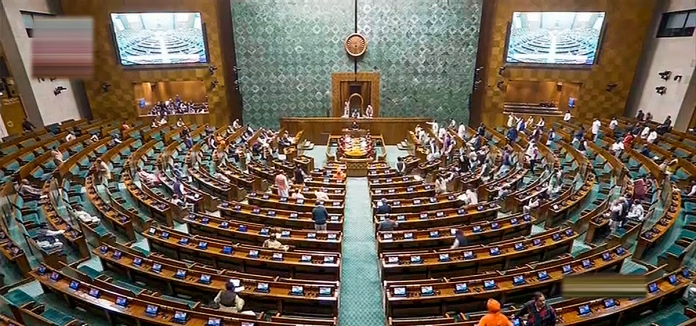
The Centre’s sudden decision to reconvene Parliament from November 30, 2026, has ignited a political firestorm over constitutional propriety and democratic accountability. Announced by Union Parliamentary Affairs Minister Kiren Rijiju, the special sitting will bring back the Lok Sabha on November 30 and the Rajya Sabha on December 2, concluding by December 3. Rather than summoning a regular Winter Session, the government is resurrecting the Monsoon Session—which was adjourned sine die on August 13 but deliberately kept unprorogued for more than 100 days.
At the heart of this maneuver is an amended version of the contentious Constitution Amendment Bill linking delimitation to 33 percent women’s reservation, a legislative push that suffered a humiliating defeat in the Lower House earlier this year.
The Congress and broader Opposition have launched a blistering counter-offensive, accusing the Narendra Modi government of subverting parliamentary norms to force through a sweeping electoral overhaul. Congress General Secretary Jairam Ramesh branded the 105-day gap between sessions as “105 days of Operation Lotus”, alleging the ruling coalition spent over three months engineering defections and political realignments to manufacture the elusive two-thirds majority required for a constitutional amendment. With recent breakaways—including 20 rebel Trinamool Congress MPs aligning with the NDA and six Shiv Sena (UBT) MPs joining the Eknath Shinde faction—the treasury benches are hovering near the 353-vote mark in the Lok Sabha, leaving the outcome precariously balanced on attendance and abstentions.
Opposition leaders argue that bypassing a full Winter Session strips lawmakers of critical oversight tools. Bulletins for the special sitting confirm there will be no Question Hour, no Zero Hour, and no Private Members’ Business. Congress MP Manish Tewari warned that the move “mocks the institution of Parliament”, while CPI(M) MP John Brittas cautioned that women’s empowerment must not be weaponized as a “smokescreen for electoral engineering”. By compressing debate on a bill that proposes expanding the Lok Sabha from 543 to up to 850 seats—a restructuring that could permanently alter regional political representation—the Centre stands accused of treating the legislature as a rubber stamp rather than a deliberative body.
To quell fierce resistance from southern states fearing a loss of parliamentary clout due to demographic shifts, the government is reportedly exploring a formula to increase Lok Sabha seats by 50 percent across all states while preserving existing inter-state ratios based on the 1971 Census. Meanwhile, Prime Minister Narendra Modi has framed the push as delivering long-overdue justice to Nari Shakti, blaming Opposition obstruction for previous delays.
Yet, the optics of an unprorogued House, three-day notice periods, and suspended parliamentary scrutiny cast a long shadow over the proceedings. With the Opposition simultaneously mobilizing against the Special Intensive Revision of electoral rolls and demanding the resignation of Chief Election Commissioner Gyanesh Kumar, the upcoming four-day sitting promises high-stakes confrontation. Ultimately, the battle beginning November 30 is no longer just about seat counts or reservation quotas—it is a defining test of whether constitutional transformation can be engineered through procedural shortcuts and fractured mandates.
🌐 Stay Connected with The Avenue Mail
Get the latest news and breaking updates delivered instantly to your feed.
🟢Join our WhatsApp Group: Click here to join
📢 The Avenue Mail: Your trusted source for real-time news.
